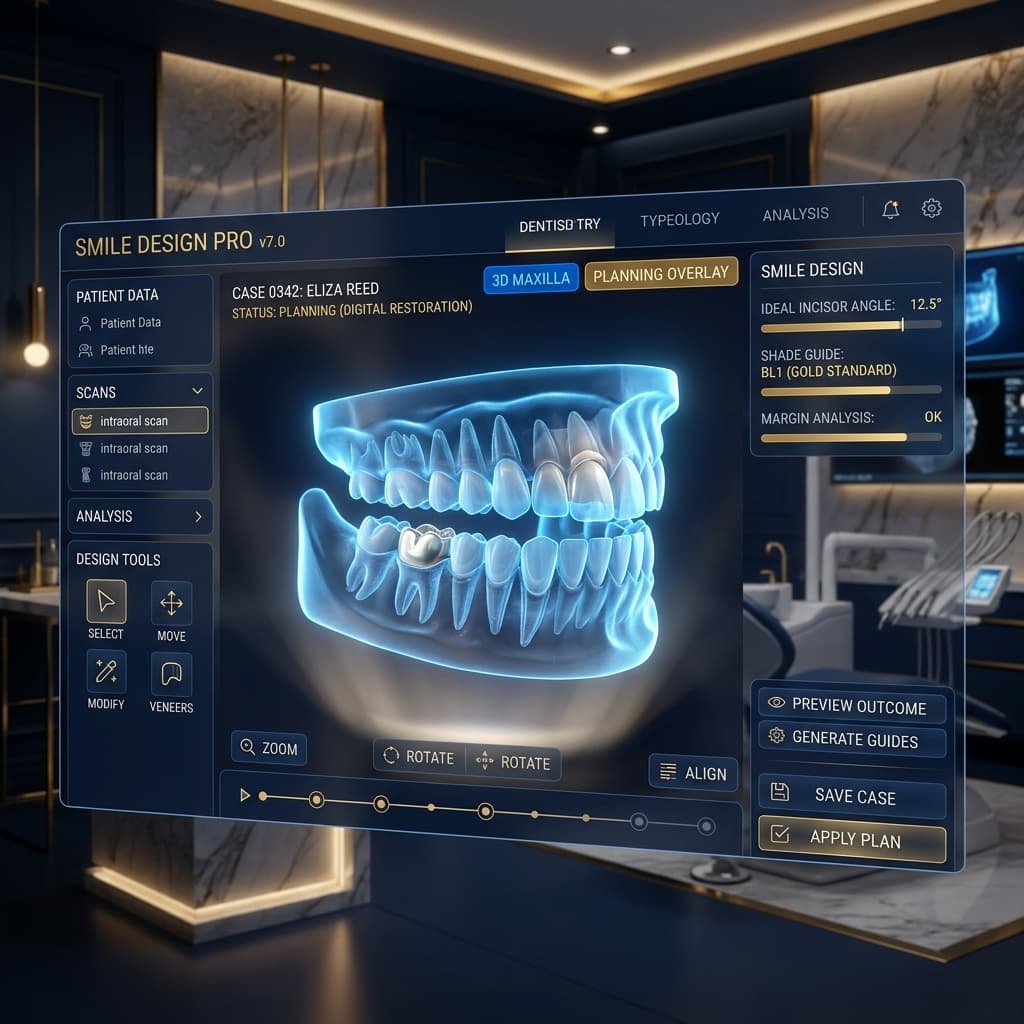
Digital Smile Design & 3D Imaging: Clinical Applications in Aesthetic Dentistry
Published: 2026-06-20
Last Updated: 2026-08-23
Meva Clinic Dental Care Team
3 Min Read
An objective medical guide distinguishing digital smile planning, optical scans, and Cone-Beam CT (CBCT), explaining indications for veneers, zirconium crowns, and implants.
Modern aesthetic dentistry combines diagnostic imaging and computer-aided planning to evaluate facial harmony, dental proportions, and functional occlusion. Digital Smile Design (DSD) integrates facial photography and intraoral optical scans to simulate prospective aesthetic changes, while Cone-Beam Computed Tomography (CBCT) provides three-dimensional radiographic bone evaluations where clinically justified. For international patients exploring aesthetic dental treatments in Istanbul, understanding how these diagnostic tools support clinical decision-making is essential. Explore our specific treatment guides on Zirconium Crowns, Dental Implants, and Hollywood Smile Design.
Clinical Assessment
Would you like a confidential medical review?
Share your treatment question with our international patient team. Suitability and treatment decisions are confirmed by the responsible licensed physician after clinical assessment.
Please do not send sensitive medical documents in your first message. Our team will explain the secure next step.
Distinguishing Digital Smile Design, Optical Scanning, and CBCT
It is important to differentiate the roles of various digital dental technologies. Digital Smile Design (DSD) is an aesthetic planning workflow that analyzes high-resolution facial photographs and video to map tooth proportions relative to the lips, smile arc, and facial midline. Intraoral Optical Scanners capture high-precision digital impressions of teeth and gums without messy conventional impression materials. In contrast, Dental Cone-Beam CT (CBCT) is a specialized 3D radiographic modality (regulated by authorities such as the FDA) utilized selectively for surgical and anatomical evaluations—such as measuring jawbone density and volume, locating the mandibular nerve canal, or assessing the maxillary sinus prior to dental implant placement.
Treatment Modalities: Veneers, Zirconium Crowns, and Implants
Restoration Type
Clinical Indication
Tooth Preparation Scope
Diagnostic Imaging Needs
Porcelain / E-max Veneers
Minor misalignment, discoloration, or chips in anterior teeth.
Conservative enamel preparation on the visible front surface.
Standard intraoral photographs, optical scans, and 2D periapical X-rays.
Zirconium Crowns
Extensive decay, fractures, or structural bite rehabilitation.
Circumferential tooth preparation to accommodate full-coverage crown.
Periapical/panoramic X-rays and digital intraoral scans.
Dental Implants
Replacement of missing single, multiple, or full-arch teeth.
Surgical placement into jawbone; no alteration of adjacent natural teeth.
Mandatory 3D CBCT scan to evaluate bone volume and nerve pathways.
Radiation Safety, Clinical Reality, and Biological Limits
Dental clinicians adhere to the ALARA/ALADA (As Low As Reasonably Achievable/Diagnostically Acceptable) principle for radiation safety: 3D CBCT scans are not performed indiscriminately for every patient, but rather when 2D imaging is insufficient for surgical implant safety. Furthermore, digital simulations provide an aesthetic reference blueprint; final outcomes depend on individual periodontal health, bite mechanics, and oral hygiene compliance.
Frequently Asked Questions
Does every dental patient require a 3D CBCT scan?↓
No. CBCT is indicated primarily for surgical implant planning, bone grafting, or complex endodontic/anatomical evaluations. Veneers and routine crowns are typically planned using optical impressions and standard 2D digital X-rays.
Can I preview my new smile before irreversible tooth preparation?↓
Yes. Digital smile simulations and temporary diagnostic mock-ups allow patients to evaluate tooth proportions, shape, and speech dynamics before final restorations are fabricated.
Clinical Assessment
Would you like a confidential medical review?
Share your treatment question with our international patient team. Suitability and treatment decisions are confirmed by the responsible licensed physician after clinical assessment.
Please do not send sensitive medical documents in your first message. Our team will explain the secure next step.
This content is maintained by Meva Clinic’s Clinical Care Team for patient guidance and clinical transparency. Final treatment suitability, operating physician assignment, surgical planning, and medical decisions are confirmed only after medical history review, in-person consultation, diagnostic tests, anesthesia evaluation, and doctor availability.
Meva Clinic Clinical Care
Partner Hospital Quality & Medical Network Standards
JCI Partner Hospitals
ISO / TÜV Quality Standards
Licensed Providers in Türkiye
ISAPS-Affiliated Partner Surgeons
International Quality Management
Accreditation and society references relate to selected partner hospitals, provider institutions, or individual partner surgeons where applicable. Meva Clinic coordinates international patient care through licensed healthcare providers and specialist medical partners.