


The Evolution of Sapphire FUE: Surgical Principles, Donor Safety & Aesthetic Outcomes
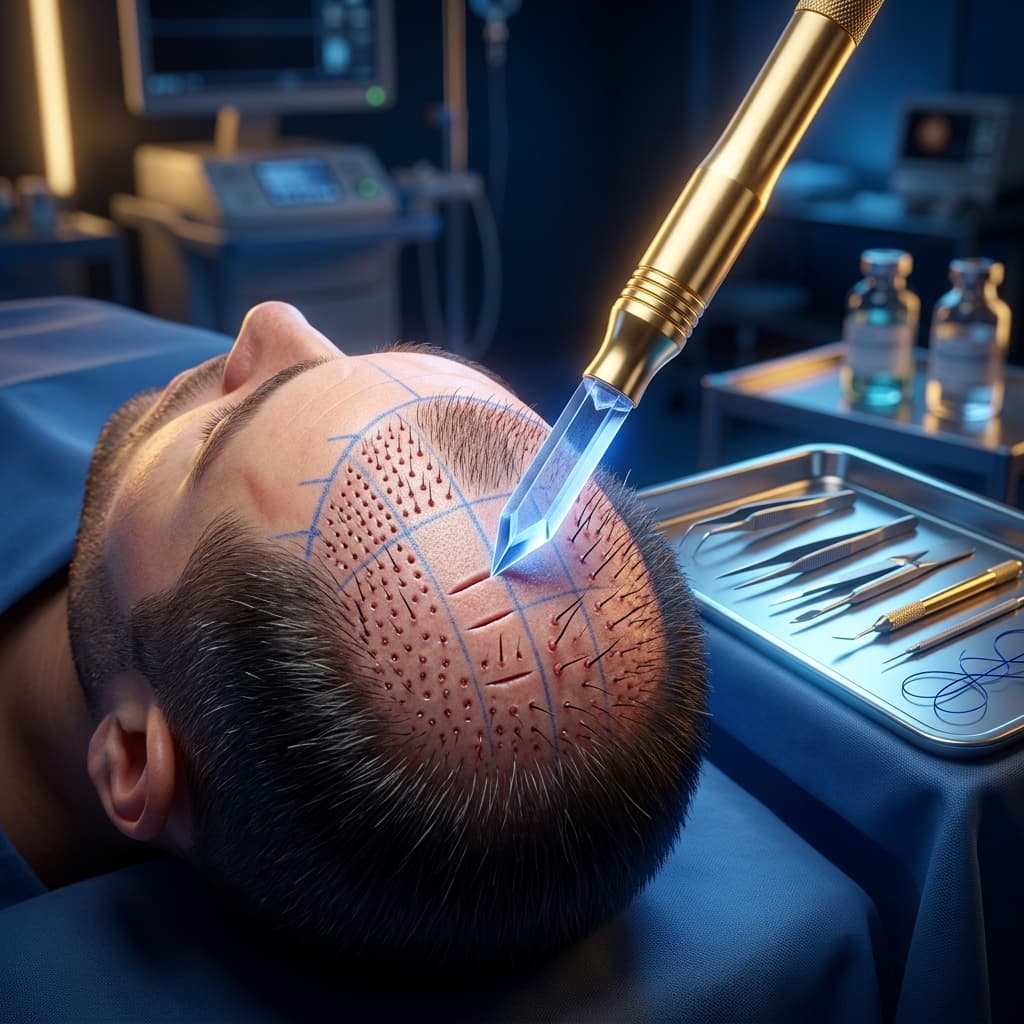
A medical review detailing how Sapphire gemstone blades shape recipient channels in FUE hair restoration, explaining donor management, healing biology, and procedural distinctions from DHI.
Follicular Unit Extraction (FUE) represents the cornerstone of modern hair restoration, defined by the individual harvesting of follicular units from the genetically stable donor area (the occipital and parietal scalp). In Sapphire FUE, recipient site creation utilizes specialized synthetic sapphire (corundum) blades rather than conventional surgical steel slits. Understanding the technical nuances, donor capacity limits, and biological healing phases is essential for patients considering hair restoration in Istanbul. Learn more about our specialized pathways on Sapphire FUE Hair Transplant and DHI vs FUE Comparison.
Would you like a confidential medical review?
Share your treatment question with our international patient team. Suitability and treatment decisions are confirmed by the responsible licensed physician after clinical assessment.
Please do not send sensitive medical documents in your first message. Our team will explain the secure next step.
Surgical Mechanics: Sapphire Micro-Blades vs. Steel Slits
Procedural Comparison: Sapphire FUE and DHI
| Procedural Parameter | Sapphire FUE | Direct Hair Implantation (DHI) |
|---|---|---|
| Recipient Site Creation | Pre-made micro-incisions using customized sapphire gemstone blades. | Simultaneous incision and placement using Choi Implanter pens. |
| Graft Handling | Manual placement into pre-cut channels with fine micro-forceps. | Grafts loaded into implanter needle and injected directly into scalp. |
| Typical Indication | Large recipient areas requiring higher graft volume sessions. | Targeted hairline refinement and density enhancement between existing hairs. |
| Recipient Shaving | Shaving of recipient area generally recommended for optimal visibility. | Can be performed with partial or unshaven recipient protocols in selected cases. |
Donor Management, Risks, and Biological Healing
Frequently Asked Questions
Is Sapphire FUE completely scarless?↓
No surgical hair restoration is entirely scar-free. FUE produces microscopic dot-like scars in the donor region that are typically undetectable beneath normal hair length, unlike linear strip scars.
How long until transplanted hair shows final density?↓
Initial transplanted hairs typically shed between weeks 2 and 8 (shock loss). New active growth begins around month 3–4, with mature density and natural texture developing between months 10 and 14.
What determines if I am a suitable candidate for Sapphire FUE?↓
Suitability depends on donor hair density, caliber, scalp elasticity, stability of hair loss pattern, and realistic expectations determined during clinical consultation.
Would you like a confidential medical review?
Share your treatment question with our international patient team. Suitability and treatment decisions are confirmed by the responsible licensed physician after clinical assessment.
Please do not send sensitive medical documents in your first message. Our team will explain the secure next step.
Patient Care Information
Meva Clinic Hair Restoration Care Team
Hair Restoration & Trichology Care Guidance
This content is maintained by Meva Clinic’s Clinical Care Team for patient guidance and clinical transparency. Final treatment suitability, operating physician assignment, surgical planning, and medical decisions are confirmed only after medical history review, in-person consultation, diagnostic tests, anesthesia evaluation, and doctor availability.
Partner Hospital Quality & Medical Network Standards
Accreditation and society references relate to selected partner hospitals, provider institutions, or individual partner surgeons where applicable. Meva Clinic coordinates international patient care through licensed healthcare providers and specialist medical partners.